
Know Your Eyes
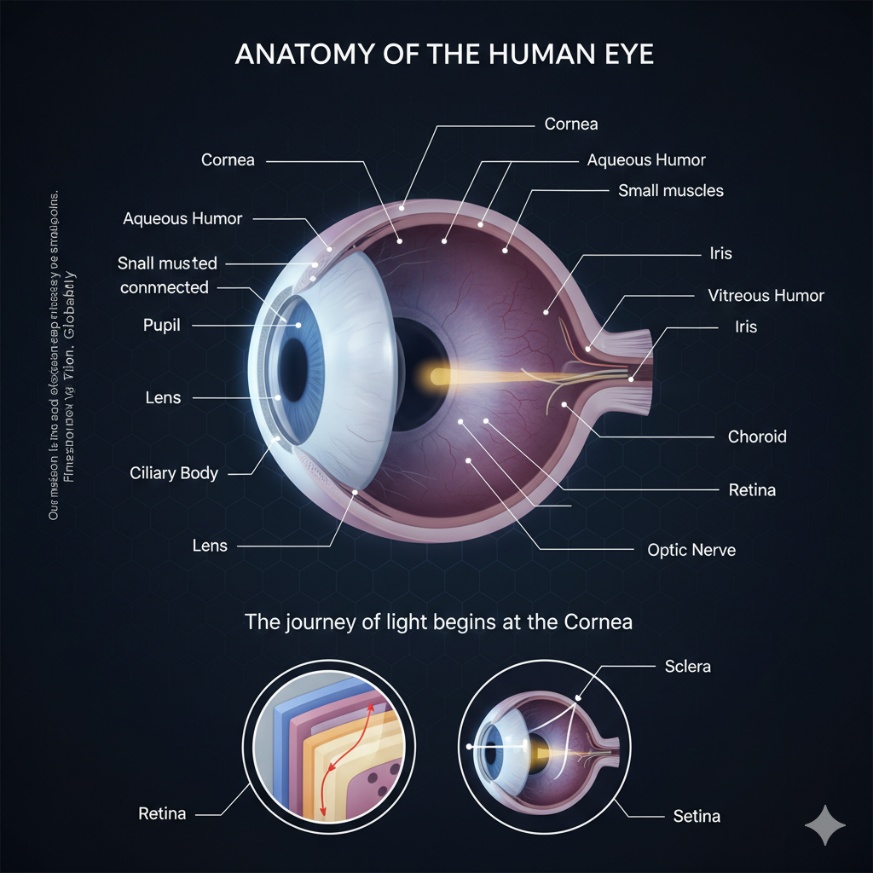
Understanding the basic anatomy of the eye is key to appreciating how we see the world. Our eyes are intricate organs, constantly working to process light and transmit visual information to our brains. The journey of light begins at the Cornea, the transparent, dome-shaped front surface that focuses light. Behind it lies the Iris, the colored part of your eye, which controls the size of the Pupil—the black opening that regulates how much light enters. The light then passes through the Lens, which fine-tunes the focus, allowing us to see objects at various distances. The Ciliary Body helps the lens change shape for this focusing ability. The main chamber of the eye is filled with Vitreous Humor, a gel-like substance that maintains its spherical shape. At the back of the eye, the light hits the Retina, a light-sensitive layer containing millions of photoreceptor cells (rods and cones). These cells convert light into electrical signals. The Choroid, a layer between the retina and sclera, provides essential nutrients. Finally, these signals are sent to the brain via the Optic Nerve, where they are interpreted as the images we see. The protective white outer layer of the eye is called the Sclera. Understanding these parts helps us appreciate the complexity and fragility of our vision.
Ophthalmic Industry - An Outlook
The ophthalmic industry is in a period of rapid and exciting transformation, driven by technological innovation and a growing global need for advanced eye care. According to recent market analyses, the global ophthalmic market is projected to reach over $144 billion by 2034, propelled by an aging population and the increasing prevalence of common eye diseases like cataracts, glaucoma, and diabetic retinopathy. A key trend is the integration of cutting-edge technologies. Artificial intelligence (AI) is revolutionizing diagnostics, enabling automated screening for conditions like diabetic retinopathy and macular degeneration, and significantly enhancing the speed and accuracy of early detection. In the surgical space, robot-assisted procedures and advanced laser systems are becoming more common, offering unparalleled precision and improved patient outcomes. Furthermore, there is a strong focus on developing novel therapeutic solutions. Gene therapies are emerging as a promising frontier for treating inherited retinal diseases, offering the potential for "one and done" treatments that address the root cause of vision loss. Meanwhile, the demand for minimally invasive glaucoma surgeries (MIGS) and premium intraocular lenses (IOLs) continues to rise, reflecting a patient-driven desire for more effective, less invasive procedures. As the industry continues to evolve, innovation, accessibility, and patient-centered care are at the forefront. These advancements are not only transforming how eye care is delivered but also ensuring that more people worldwide can access the vision-saving treatments they need.